
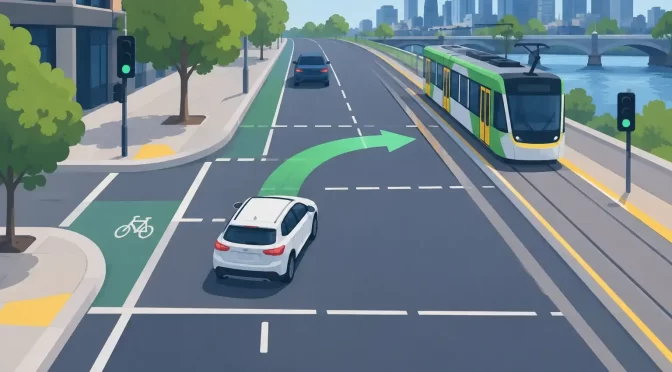
A Melbourne hook turn can feel backwards the first time you see one. You want to turn right, but instead of moving into the right-hand lane, you move left, enter the intersection, wait, then complete the turn when the lights change. Knowing when to use Melbourne hook turns takes away the guesswork and helps you drive calmly around trams, cyclists, busy traffic and CBD intersections.
For learner drivers, the goal is not to rush through a hook turn. It is to recognise the signs early, choose the correct lane, communicate clearly and wait in the right position. With the right routine, it becomes a straightforward manoeuvre rather than a stressful surprise.
What is a Melbourne hook turn?
A hook turn is a right turn made from the left-hand side of the road at selected intersections. It is used mostly in central Melbourne where tram tracks and heavy traffic make a conventional right turn less practical.
You will see a hook turn sign at intersections where the rule applies. The sign shows a vehicle making a right turn from the left lane. If there is no hook turn sign, do not assume you should perform one. Follow the lane arrows, traffic signs and road markings at that particular intersection.
Hook turns help keep the right-hand lanes clear for trams and through traffic. They can look unusual to drivers from interstate or overseas, but they are a normal part of driving safely in Melbourne.
When to use Melbourne hook turns
Use a hook turn only at an intersection where a hook turn sign tells you to do so. In many CBD locations, the sign applies during particular hours, so read the entire sign rather than relying on what you remember from another intersection.
A hook turn is not an optional alternative to a normal right turn. If the sign requires it, you must make the turn from the left lane. If the sign does not require it, use the lane that the road markings and signs direct you to use.
This matters because Melbourne streets can change quickly. A lane may be shared with cyclists, a tram may be approaching behind you, or a clearway restriction may apply at certain times. Good drivers scan ahead early instead of making last-second lane changes near the intersection.
Watch for these clues before the intersection
Hook turn signs are your main clue, but do not wait until you are at the stop line to look for them. As you approach, check overhead signs, roadside signs, lane arrows and tram tracks. If you know you need to turn right, look well ahead so you have enough time to move into the left lane safely.
Keep checking your mirrors before changing lanes and give a clear right indicator before the intersection. Your indicator tells other road users what you plan to do, even though your car is positioned to the left. This is one of the reasons hook turns can confuse inexperienced drivers, so make your signal deliberate and consistent.
How to complete a hook turn step by step
The procedure is simple once you understand why each step matters.
First, approach in the left-hand lane unless signs or road markings tell you otherwise. Indicate right and position your vehicle as far left as practical, without blocking a cyclist or entering an area you should not use.
When the traffic light turns green, drive into the intersection. Do not turn right immediately. Move forward and wait on the left side of the intersection, behind any pedestrian crossing and out of the path of traffic using the cross street.
While waiting, keep your wheels straight and stay alert. Check for pedestrians crossing the road you are entering, cyclists travelling through the intersection, trams and other vehicles. You may need to wait through part of the light cycle.
Complete your right turn when the traffic lights for the road you are entering turn green, or when a green arrow allows the movement. Before moving, make sure the path is clear and give way where required. Then turn smoothly into the correct lane, cancel your indicator if needed and continue at a safe speed.
The key point is this: you are waiting for the traffic on the road you are turning into to be stopped by a red light. You are not trying to force your way across vehicles travelling straight ahead.
Common mistakes learners make
The most common mistake is approaching from the right lane because it feels natural for a right turn. At a signed hook turn intersection, that position can block trams and put you in the wrong place.
Another mistake is waiting too far back at the stop line. Once the light is green, you need to enter the intersection and wait in the designated left-side area. Staying behind the line may prevent you from completing the turn safely and can hold up traffic behind you.
Some drivers also turn too early. Remember that a hook turn is completed only when the signals for the road you are entering allow it. If pedestrians are still crossing, a cyclist is passing through, or traffic has not stopped, wait.
Finally, avoid focusing only on the lights. Melbourne CBD driving requires wide observation. Look ahead, check your mirrors, scan both sides of the intersection and be aware of trams. A calm, steady observation routine is safer than staring at one signal and reacting late.
Hook turns, trams and cyclists
Trams are one of the main reasons hook turns exist. Never stop where you obstruct a tram unless traffic conditions leave you no safe alternative. Watch for tram tracks, especially when the road is wet, as they can be slippery for tyres and hazardous for cyclists.
Cyclists may be travelling along the left side of the road as you prepare for the turn. Check your left mirror and blind spot before moving left. Do not cut across a cyclist’s path just to reach the correct position at the last moment. If it is not safe to move over, continue ahead and find a safe place to change direction later.
Pedestrians also have priority at crossings. Even when you receive a green light to finish the hook turn, people may still be legally crossing the road. Patience is part of safe driving, and it is always better to wait a few extra seconds than create a dangerous situation.
Are hook turns included in the VicRoads driving test?
A hook turn is not a trick that every learner will face on a driving test. Your test route depends on the location and traffic conditions on the day. However, VicRoads assessors expect you to follow signs, make safe decisions and respond correctly to the road environment wherever you are driving.
If your test is in or near an area with tram routes and hook turn intersections, being prepared is sensible. The assessor is looking for safe observation, correct positioning, good speed control and sound judgement. They are not looking for a rushed manoeuvre performed from memory.
For overseas licence holders, hook turns can be particularly unfamiliar because few cities use them in the same way as Melbourne. A practical lesson gives you the chance to practise the approach and timing with a patient instructor beside you, before you need to manage it in busy traffic alone.
Build confidence before you need one
The best way to handle a hook turn is to practise it progressively. Start by identifying hook turn signs as a passenger or during a quieter drive. Then practise approaching the correct lane, signalling, entering the intersection and waiting in the right position. Once that feels comfortable, move to busier conditions with trams, pedestrians and more traffic.
At Learning Path Driving School, instructors can include Melbourne CBD road rules, tram awareness and hook-turn practice in lessons that match your current confidence level. You do not need to learn everything at once. Clear feedback and repeated practice help the sequence become natural.
If you are ever unsure at a busy intersection, do not panic or make a sudden move. Stay in your lane, continue safely if necessary and plan your next turn. A missed turn costs a few minutes. A calm decision protects you, your passengers and everyone sharing the road.