A three-point turn can feel awkward at first because you are steering, selecting gears and watching for traffic in a confined space. Once you understand the three point turn steps, though, it becomes a calm, controlled manoeuvre rather than a rushed series of turns. The goal is not to finish quickly. It is to turn the vehicle around safely, legally and without making other road users react to you.
For Victorian learners, this skill builds the low-speed control and observation habits that matter across your driving test. A patient instructor can help you practise it in suitable Melbourne streets until the steering and safety checks feel natural.
Before You Start a Three-Point Turn
A three-point turn is used to reverse the direction of your vehicle on a narrow, quiet road when there is not enough room to make a U-turn in one movement. It should never be your default choice on a busy street. If traffic, parked cars, pedestrians or poor visibility make the manoeuvre difficult, keep driving and find a safer place to turn around.
Choose a level, quiet section of road with enough width and clear sight lines in both directions. Avoid bends, crests, pedestrian crossings, driveways with vehicles exiting, narrow streets packed with parked cars, and locations near schools or busy shopping areas. In Melbourne, also be especially careful around tram routes, bicycle lanes and streets where traffic can appear quickly from side roads.
Check signs and road markings before you begin. You must not perform a manoeuvre where it is prohibited or where it would create a hazard. You are responsible for giving way to other vehicles, cyclists and pedestrians throughout the turn. If someone approaches, stop safely and wait. Forcing another driver to brake is a clear sign that the location or timing was wrong.
Set yourself up close to the left kerb, leaving enough space to move off smoothly. Check your mirrors, look over your right shoulder for blind-spot traffic and signal right when it is safe to begin. Keep your hands ready for controlled steering and bring the vehicle to a complete stop before changing between drive and reverse.
Three Point Turn Steps: The Safe Method
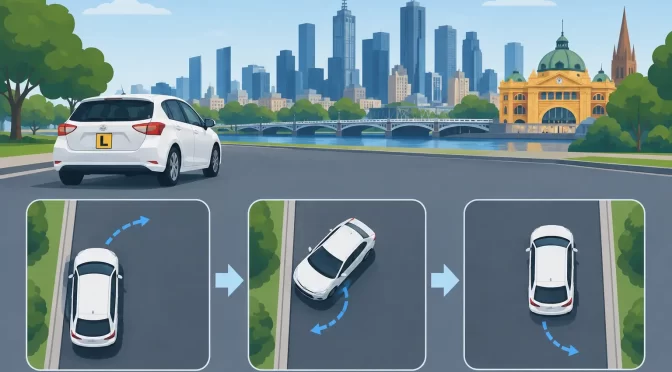
The exact steering amount will vary with the width of the road, your vehicle’s turning circle and parked cars. These three point turn steps give you the safe sequence to practise. Focus on slow movement, constant observation and keeping well clear of both kerbs.
1. Move forward towards the opposite side
After your mirror, blind-spot and traffic checks, move forward very slowly while steering to the right. Look well ahead and towards the area where you want the front of the vehicle to travel, rather than staring at the kerb.
Use gentle accelerator control in an automatic. In a manual, use clutch control and light acceleration so the car crawls forward without rolling or stalling. Turn the steering wheel steadily, not abruptly, and be prepared to stop if a pedestrian, cyclist or vehicle enters the area.
Approach the opposite kerb with plenty of clearance. Do not let the wheels hit or mount the kerb. Stop with the vehicle angled across the road, leaving enough room for the reversing part of the manoeuvre. Apply the brake firmly and select reverse only when the car is fully stationary.
2. Reverse back towards your original side
This is the stage where learners often forget observation. Before reversing, check mirrors, look through the rear window and complete a full all-round check. Pay close attention to the left rear area, as pedestrians can step off the footpath and vehicles can approach from behind while you are preparing to move.
When it is clear, reverse slowly while steering left. Your aim is to bring the rear of the vehicle back towards the kerb where you started, without touching it. Keep your speed at walking pace. If you lose your position, stop, reassess and correct calmly rather than rushing the wheel.
You may need to glance through the rear window while also checking around the vehicle. Do not reverse on guesswork or rely only on reversing cameras and sensors. They can assist you, but they do not replace direct observation. Keep scanning until you stop near the original side of the road with enough room to drive forward.
3. Drive forward and complete the turn
Come to a complete stop, select drive or first gear, and carry out another all-round observation check. Traffic conditions can change in seconds, particularly in suburban Melbourne streets where cars are parked along both sides.
Move forward slowly, steering right as required to bring the vehicle into the left side of the road in your new direction. Straighten the wheels as the car lines up, cancel the indicator if it has not cancelled itself, and build speed only when you have a clear road ahead.
Finish in a normal driving position, not too close to the kerb and not drifting towards the centre of the road. Check your mirrors, look ahead and continue driving smoothly. A neat finish shows that you remained aware of the wider traffic environment, not just focused on the turn itself.
The Observation Routine That Keeps You Safe
A three-point turn is assessed by more than steering accuracy. Safe observation is the part that protects you and demonstrates sound driving judgement. Before each movement, scan mirrors, blind spots and the relevant direction of travel. While moving, keep looking where the vehicle is going and continue checking for changing hazards.
Think of the routine as observe, decide, move slowly, then observe again. There are three separate movements, so there should be three separate safety checks. This is particularly important before reversing, when pedestrians, cyclists and children can be harder to see.
If a car approaches while you are halfway through the turn, do not panic. Stop, keep the brake applied and let it pass if it is safe to do so. You may need to wait longer than expected. That is good driving judgement, not a mistake. Trying to complete the manoeuvre in front of approaching traffic creates unnecessary pressure and risk.
Common Mistakes Learners Can Avoid
The most common issue is starting in the wrong location. A tight road, hidden bend or busy traffic flow can turn a simple manoeuvre into a difficult one. Good drivers choose the safe option before they touch the steering wheel.
Another frequent mistake is moving too fast. Speed reduces your time to steer accurately, judge clearance and react to people or vehicles. Keep each movement slow enough that you could stop immediately if needed. Smooth clutch control is particularly valuable for manual learners, while automatic drivers should use light brake and accelerator control rather than letting the vehicle creep too quickly.
Kerb contact is also avoidable with better forward planning. Look where you want the car to go, not down at the front wheel. If you feel you are getting too close, stop before contact, assess your position and make a controlled correction. Mounting the kerb can damage tyres and wheels, and it shows that vehicle control needs more practice.
Finally, do not treat mirror checks as a quick glance. Examiners and instructors look for effective observation, but more importantly, road users depend on it. Make your head checks clear and purposeful, especially before reversing and before moving back into traffic.
Will You Need a Three-Point Turn in a Victorian Driving Test?
A driving test assesses your ability to operate the vehicle safely and respond to directions in real traffic conditions. You may be asked to complete a turning manoeuvre when it is legal and appropriate, but you should not assume that every test includes the same task in the same location.
The best preparation is to understand the safety principles behind the manoeuvre: selecting a safe location, maintaining control, observing properly and giving way when required. Those same skills apply to parking, U-turns, leaving the kerb and reversing exercises.
During a test, listen carefully to the examiner’s direction. If you are unsure, ask for the instruction to be repeated before moving. Do not begin a manoeuvre simply because you feel pressured to act quickly. A brief pause to check signs, traffic and available space is far better than choosing an unsafe location.
Practise Until It Feels Predictable
Start practising in a quiet, wide street with an experienced supervising driver or qualified instructor. Repeat the manoeuvre slowly in the same type of location until you can judge the vehicle’s width, steering response and stopping points. Then practise on slightly narrower streets and in different conditions, always choosing places where the turn is legal and safe.
Learning Path Driving School helps Melbourne learners build this skill through clear instructions, patient coaching and practical feedback matched to current Victorian test expectations. Whether you drive manual or automatic, focused practice can turn a stressful manoeuvre into one more thing you can handle confidently.
The best three-point turn is rarely the fastest one. It is the one completed with calm observation, controlled steering and enough judgement to wait when the road is not right.