A parallel park can feel like the moment the whole test depends on one manoeuvre. For the parallel parking driving test Victoria learners face, it is not about producing a perfect-looking park in one dramatic turn. It is about showing that you can assess the space, observe properly, control the car at low speed and finish in a safe, legal position.
That is good news if you are nervous. Parallel parking is a skill with a repeatable process. Once you understand the sequence in the vehicle you will use on test day, it becomes far more manageable than trying to guess your way into a space.
What the assessor looks for during parallel parking
Your driving test assessor is watching the whole manoeuvre, not only where the car ends up. A neat final position matters, but safe decision-making matters just as much.
Before moving, you need to identify a suitable space and set up without creating a problem for traffic behind you. During the manoeuvre, your assessor will be looking for effective observation, appropriate signalling, slow and controlled steering, and awareness of other road users. This includes checking mirrors and looking over your shoulder before reversing, then continuing to scan as the situation changes.
At the end, the vehicle should be reasonably close to and parallel with the kerb, without touching it or finishing at an unsafe angle. You must also avoid contacting another vehicle, blocking traffic unnecessarily or relying on rushed corrections.
A correction is not automatically a failure. In fact, a calm correction can show good judgement when it is completed safely. The problem is losing observation, rolling too quickly, mounting the kerb or creating danger while trying to rescue the park.
Does every Victorian driving test include parallel parking?
Do not assume you will definitely be asked to complete a parallel park on every test. The exact tasks can vary according to the test route, local conditions and the assessor’s directions. You may be asked to perform another low-speed manoeuvre instead.
Still, parallel parking is worth practising properly. It builds skills you use well beyond the test: reversing safely near parked cars, judging your vehicle’s dimensions and staying composed when the road feels tight. If it comes up on your test, you want the instruction to feel familiar rather than frightening.
Parallel parking driving test Victoria: a reliable method
The reference points that work for one car may not work in another. A hatchback, sedan and SUV have different lengths, mirror positions and turning circles. Learn the method first, then practise the visual cues in the same car you plan to drive for your test where possible.
1. Choose the space and prepare early
When directed to park, check that the space is practical. You need enough room to complete the manoeuvre without forcing other vehicles to move or taking unnecessary risks. Slow down smoothly, check your mirrors and indicate left in good time.
Pull up beside the vehicle in front of the space, keeping a sensible side distance. Your instructor can help you find the ideal position for your car, but avoid getting so close that you risk scraping mirrors or make the reverse angle difficult.
Before selecting reverse, check all around the vehicle. Look in the rear-view mirror and side mirrors, then perform a clear head check towards the rear and blind spot. A cyclist, pedestrian, scooter rider or car can appear quickly, particularly on busy Melbourne streets.
2. Reverse slowly with full observation
Select reverse and begin moving only when it is safe. Keep the pace walking-slow. Low speed gives you time to steer accurately, check surroundings and stop if another road user enters the area.
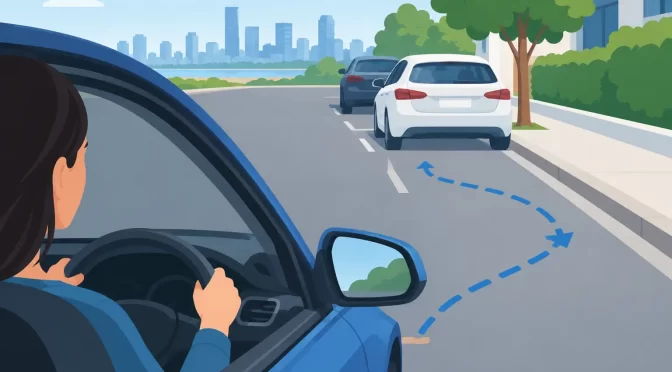
As a general sequence, reverse back while steering towards the kerb so the rear of your car enters the space. When your vehicle reaches the appropriate angle, straighten the steering briefly, then steer away from the kerb to bring the front of the car in.
That sounds simple on paper, but the timing is personal to the vehicle. Do not copy a friend’s exact reference point just because it worked in their car. Use your mirrors to monitor the kerb and parked vehicles, and ask your instructor to help you build reliable cues based on your seating position and vehicle.
3. Finish straight, safe and controlled
Once the car is inside the space, straighten the wheels and assess the final position. You should not be sitting far out into the traffic lane, and you should not have touched the kerb. Leave practical room from the cars in front and behind so everyone can move safely.
If you need to adjust, take a breath and do it carefully. Check around the vehicle again before moving forward or backwards. One safe correction is much better than continuing into a poor position because you are worried about taking extra time.
When you are finished, secure the vehicle as instructed. If you are parking and leaving the car, remember the correct parking procedure for the conditions, including checking before opening a door towards traffic or a bike lane.
The observation mistakes that cost learners marks
Many learners can physically steer into a space but lose marks because their observation disappears once they concentrate on the kerb. The car is moving backwards, so your awareness needs to be active from start to finish.
Avoid staring only at the left mirror. Use the mirror to judge your distance from the kerb, but regularly look behind and around the car. If a pedestrian walks near the rear of the vehicle, stop. If a car approaches closely or another driver is confused by your intentions, remain patient and wait until it is safe.
Also avoid treating the indicator as a substitute for observation. Signalling tells others what you intend to do. It does not confirm that the path is clear. The assessor needs to see both communication and proper checks.
Common parallel parking problems and how to fix them
Parking too far from the kerb usually happens when learners turn away from the kerb too early or stop the reverse manoeuvre before the car is properly aligned. Practise the straightening phase at a slower speed and learn what the kerb looks like in your mirror when the car is correctly positioned.
Touching the kerb is often caused by watching the kerb too late, reversing too quickly or applying too much steering lock. Slow the car down and make smaller, earlier adjustments. In an automatic, controlled brake pressure is often more useful than trying to manage the manoeuvre with the accelerator.
Finishing on an angle generally means the steering was not straightened at the right time. Rather than memorising a random count of turns, learn to recognise the car’s angle through the mirrors and rear window. Your instructor can coach you through this until the correction becomes natural.
Rushing because another vehicle is waiting is another frequent issue. Other drivers may be impatient, but you are responsible for completing the manoeuvre safely. Keep your indicator on, stay calm and do not let pressure from behind make you skip a check or accelerate suddenly.
Practise for the car and the streets you will drive
Parallel parking on a quiet street with no pressure is where confidence starts. Begin with a generous space between two parked cars or markers, then gradually practise in tighter but still safe spaces. Repeating the manoeuvre in different streets helps you adapt to cambers, kerb shapes, traffic and varying vehicle sizes.
Practise in daylight first. Once you are comfortable, experience parking in light rain, at dusk or in busier local traffic with an experienced instructor beside you. These conditions change visibility and judgement, but they should be introduced progressively, not all at once.
A patient instructor can also spot the small habits that are hard to see from the driver’s seat: late head checks, drifting too close to the parked car beside you, holding the steering at full lock for too long or forgetting to scan after stopping. At Learning Path Driving School, lessons focus on building a repeatable routine in the car you are learning in, with clear feedback that prepares you for Victorian test conditions.
On test day, keep the task simple
If you are asked to parallel park, listen to the full instruction before acting. If you do not understand where the assessor wants you to park, ask for clarification while stationary. It is better to confirm the task than make an unsafe assumption.
Then use the same routine you have practised: mirrors, indicator, position, full observation, slow reverse and calm correction if needed. Do not chase perfection. Aim to show safe vehicle control and thoughtful awareness of everyone around you.
The strongest parallel park is usually not the fastest one. It is the one completed calmly, with clear checks and enough control to make a safe decision at every stage.