A school-zone mistake can happen in seconds: you are following traffic, watching for a turn, and miss the flashing sign or the time panel beneath it. This Melbourne school zone driving guide gives learner drivers a clear, practical way to approach these busy areas safely, calmly and with the road rules in mind.
School zones are not just a driving-test requirement. They are places where children may step out from between parked cars, ride unpredictably near the kerb, or cross while focused on friends rather than traffic. The right habit is simple: spot the signs early, reduce speed smoothly and expect the unexpected.
What makes Melbourne school zones different?
In Victoria, a school zone is generally a 40 km/h speed area that operates at the times shown on the signs. Many operate on school days in the morning and afternoon, but you must always read the signs at that location. Do not rely only on the usual school-zone times, your memory, or what the car in front is doing.
The signs are the legal instruction. Look for the school-zone sign as you approach, then check the days and times displayed below it. Some locations use electronic signs, while others use fixed time panels. A 40 km/h limit applies from the school-zone sign until you pass the end sign, provided it is within the signed operating period.
This is where learners can lose confidence. You may be travelling on a road normally signed at 50 km/h or 60 km/h, then need to adjust quickly. The answer is not to brake hard at the sign. Scan well ahead, ease off the accelerator early and brake progressively so your speed is already down before you enter the zone.
Melbourne school zone driving guide: the approach routine
A consistent routine makes school zones much easier. As soon as you see a school warning sign, take your foot off the accelerator and check your rear-view mirror. Begin slowing early, especially if there is a vehicle close behind. A gentle, planned reduction is safer than late braking.
Next, read the full sign. Confirm the speed limit, operating times and where the zone begins. Keep your eyes moving between the road ahead, parked vehicles, footpaths, crossings and mirrors. You are looking for hazards, not staring at the speedometer.
Once you are in the zone, hold a steady speed at or below 40 km/h when the school-zone limit applies. Leave more space than usual from the vehicle ahead. Children can be difficult to predict, and the extra gap gives you time to respond without panic braking.
For driving-test purposes, your assessor will notice whether you identify the zone promptly, select an appropriate speed and maintain awareness around pedestrians. Travelling at 40 km/h while failing to notice a child near a crossing is not good driving. Safe driving combines rule knowledge with active observation.
Check your speed without fixating on it
Learners sometimes check the speedometer so often that they stop properly scanning the road. Instead, glance at it regularly while keeping your main attention outside the vehicle. In a manual car, choose a gear that helps you maintain 40 km/h comfortably without labouring the engine or rushing to change gears.
In an automatic, avoid letting the car roll faster downhill. Light braking may be needed to keep a controlled speed. This is particularly relevant on suburban roads around Clayton, Clarinda and Mount Waverley, where changing gradients, parked cars and peak drop-off traffic can all demand attention at once.
Crossings, children and crossing supervisors
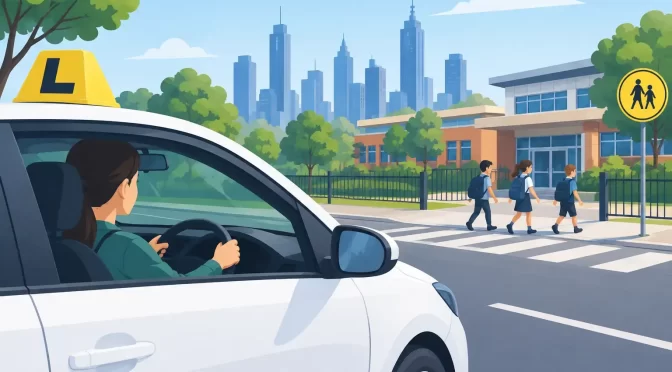
A children’s crossing needs extra care. Where flags are displayed, you must stop before the stop line and remain stopped until the flags are removed and pedestrians have left the crossing. Never edge through a crossing because you think a child has reached the other side. Wait until it is clearly safe and lawful to continue.
You may also see a crossing supervisor directing children. Follow their signals, reduce speed early and be patient. Trying to squeeze through before a group of children crosses is unsafe, stressful and likely to be treated seriously in a driving test.
Not every crossing near a school works in exactly the same way. Pedestrian crossings, supervised children’s crossings and intersections each require slightly different observations. The constant rule is to approach at a speed that lets you stop safely if someone enters your path.
Be especially cautious when visibility is reduced by a bus, SUV, ute, rubbish truck or a line of parked cars. A child can appear from behind a larger vehicle with very little warning. Give parked vehicles enough clearance where possible, watch for movement near doors and keep both hands ready on the wheel.
Common school-zone mistakes learners can avoid
The most common error is entering the zone above the signed speed limit because the driver saw the sign too late. Build the habit of scanning far ahead whenever you are driving through residential and shopping streets. School signs are usually visible well before the speed limit begins.
Another mistake is accelerating immediately after a crossing. You may still be inside the school zone, so keep checking for the end sign. The general road limit does not resume simply because the school buildings are behind you.
Some drivers also assume a zone does not apply during holidays, on pupil-free days or outside normal pick-up times. The displayed sign controls the limit. If the sign says the zone is operating, drive to that speed. If you are uncertain, choose the safer option, slow down and carefully read the signs.
Finally, avoid copying other drivers. Someone tailgating you or travelling over 40 km/h does not change your responsibility. Hold the legal speed, remain predictable and let impatient traffic pass only when it is safe and legal to do so.
How to handle school drop-off traffic
Drop-off and pick-up periods can feel chaotic, particularly on narrow streets. Cars may stop suddenly, reverse from driveways or pull away from the kerb without much warning. Give yourself room and avoid driving beside another vehicle if it restricts your view of the road ahead.
Watch for car doors opening and parents crossing between parked cars. Indicate early if you need to turn, check mirrors and blind spots, then complete the manoeuvre slowly. If a delivery vehicle or parent has blocked part of your lane, do not rush around it. Check for oncoming traffic, leave sufficient space and move only when you have a clear view.
Your horn should not be used to pressure pedestrians or other drivers in a school area. Patience is part of safe, confident driving. Arriving a minute later is always better than creating a dangerous situation.
Building test-ready habits before your VicRoads drive test
School zones may appear on a driving-test route, but the bigger goal is to make safe decisions without needing prompts. Practise recognising school-zone signs in different suburbs and at different times of day. Ask your instructor to include busy crossings, parked-car hazards and school pick-up traffic in your lessons.
It also helps to say your observations quietly in your head: “School sign ahead, check time, ease off, mirrors, 40 zone, crossing clear.” This simple commentary keeps your attention organised when nerves rise. With practice, the process becomes natural rather than something you need to force.
At Learning Path Driving School, patient one-to-one lessons can help you practise these decisions in real Melbourne traffic, with clear feedback on speed control, observation and hazard response. Whether you are a beginner, preparing for a VicRoads test or adapting from overseas driving experience, focused practice can turn a stressful school zone into a routine part of safe driving.
The best approach is to give school zones the time and attention they deserve. Slow down early, read every sign, leave space and expect a child to do something unpredictable. That mindset protects people around you and builds the calm judgement that stays with you long after you have your licence.