



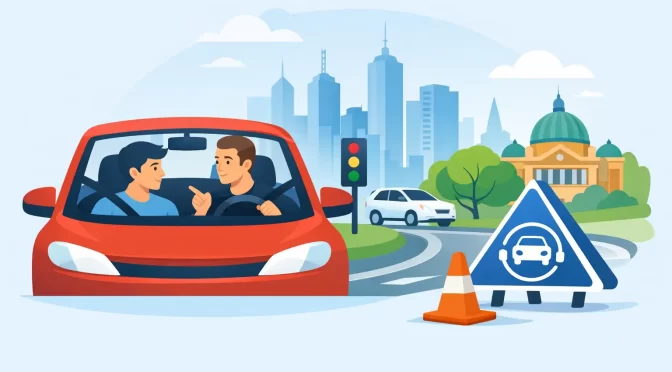
That first time in the driver’s seat can feel bigger than it should. Your hands are tight on the wheel, there is traffic behind you, and suddenly checking mirrors, indicating and steering all need to happen at once. The right beginner driving lessons Melbourne learners choose turn that pressure into a clear, manageable process.
Learning to drive is not about being perfect on lesson one. It is about building safe habits in the right order, practising them regularly and receiving calm, direct feedback from an instructor who understands Victorian roads and driving-test expectations.
What beginner driving lessons should actually teach
A quality driving lesson is more than a lap around quiet local streets. Early sessions should give you control of the vehicle first, then gradually introduce the decisions that make you a safe independent driver.
For a complete beginner, this usually starts with setting up the seat and mirrors, understanding the controls, smooth braking, steering accuracy and safe observation. Automatic lessons let many learners focus on traffic awareness sooner. Manual lessons also teach clutch control, gear selection and hill starts, so progress may feel slower at first but becomes very rewarding with consistent practice.
Once basic control feels comfortable, your instructor should introduce everyday Melbourne driving situations: roundabouts, busy intersections, lane changes, school zones, tram routes, hook turns where relevant, merging and parking. The aim is not to memorise one route. It is to learn how to read the road, plan ahead and make safe choices wherever you are driving.
Beginner driving lessons Melbourne learners can build on
Every learner starts from a different place. A teenager with no road experience needs a different approach from an adult who has put off learning for years. An overseas licence holder may already be confident behind the wheel but need support adjusting to Victorian road rules, local road layouts and test expectations.
That is why one-to-one lessons matter. A patient instructor can slow things down when you are nervous, correct a habit before it becomes harder to change and increase the challenge when you are ready. You should never feel rushed into heavy traffic before you can manage the vehicle safely. Equally, you should not stay on empty back streets so long that normal driving begins to feel intimidating.
Good instruction progresses with you. One lesson may focus on getting smooth at left and right turns. The next might introduce roundabouts or parking. Later sessions can combine these skills in busier conditions, helping you stay composed when there is more to think about.
Automatic or manual: choose for your real driving goals
For many Melbourne learners, automatic is the practical choice. It removes clutch and gear changes, which leaves more mental space for scanning intersections, judging gaps and responding to other road users. If your goal is to get confident quickly for daily commuting, work or university, automatic lessons can be an efficient path.
Manual lessons suit learners who want the flexibility to drive either transmission type once licensed. They can also be useful if your household vehicle is manual or if driving a manual is important for work. The trade-off is that early lessons require more patience. Stalling, rough take-offs and difficulty on hills are normal parts of learning, not signs that you cannot do it.
Choose the transmission that fits your likely needs, budget and timeframe. The most useful licence is the one that helps you drive safely and independently in the vehicle you will actually use.
How many lessons will you need?
There is no honest one-size-fits-all answer. Your starting confidence, access to supervised practice, ability to practise between lessons and choice of manual or automatic all affect the number of professional lessons you need.
A learner who practises regularly with a safe, supportive supervising driver may use professional lessons to sharpen technique, correct mistakes and prepare for the test. Someone without regular access to a car may benefit from more instructor-led sessions to build consistency. Adults returning to driving after a long break often progress quickly once they feel comfortable again, but may need extra work on confidence in complex traffic.
The best approach is to set a plan after your first lesson. Focus on the next skills you need rather than chasing an arbitrary number of hours. Regular sessions are usually more effective than leaving long gaps, because each lesson builds on what you have just learned.
Practise between lessons without practising the wrong habits
Professional instruction gives you structure, but supervised practice is where new skills begin to feel natural. Before practising with family or friends, agree on a calm plan. Pick one or two goals, choose an area that suits your current ability and keep the drive short enough to stay focused.
Your supervising driver should give directions early and clearly, rather than reacting at the last second. It also helps to use the same routines your instructor teaches: mirrors before moving off, clear observation at intersections, appropriate speed selection and a steady scan well ahead of the car.
Avoid turning every practice drive into a test. If you make an error, pull over safely when appropriate, talk through what happened and try again. Nervous learners improve faster when mistakes are treated as useful feedback instead of a reason to panic.
Preparing for the Victorian driving test
Passing the test is a goal, but safe driving is what gets you there. Examiners look for consistent judgement, observation and vehicle control. They want to see that you can respond to changing conditions, follow road rules and drive without creating unnecessary risk for others.
Test preparation should include the skills that commonly make learners anxious: parallel parking, reverse parking, three-point turns where required, lane changes, turning at intersections, roundabouts and safe decision-making around pedestrians, cyclists and other vehicles. It should also cover the smaller habits that are easy to overlook under pressure, such as checking mirrors before braking, maintaining an appropriate gap and using indicators correctly.
A mock test can be particularly helpful near the end of your training. It gives you a realistic run through without the stakes of the actual assessment. Your instructor can identify exactly where marks may be lost and help you fix those issues before test day.
Learning Path Driving School provides patient instruction, manual and automatic options, flexible weekday and weekend lesson times, and practical preparation based on current Victorian driving-test standards. For learners who want a focused pathway to their licence, the school’s 95% first-time pass-rate guarantee reflects a strong commitment to preparation and clear coaching.
A calmer way to begin
You do not need to arrive knowing how to park, merge or handle Melbourne traffic. You only need to begin with an instructor who explains each step clearly and gives you the space to learn it properly. Book lessons around your schedule, practise steadily between sessions and let confidence grow from real skill, one safe drive at a time.
