A road sign can change your decision in seconds. Miss a school-zone sign, a hidden give way line or a parking restriction, and you may create a dangerous situation or lose marks on your VicRoads driving test. Learning how to read road signs is not about memorising random pictures. It is about spotting the sign early, understanding what it requires, and responding safely and smoothly.
For Melbourne learners, this matters everywhere from busy Clayton intersections to quiet residential streets in Mount Waverley. Signs often appear alongside trams, cyclists, parked cars, changing speed limits and heavy traffic. The earlier you can read the road, the calmer and more confident your driving becomes.
Read the sign before you reach it
A sign is only useful if you see it with enough time to act. New drivers often look directly at the car ahead, then notice a sign too late and brake suddenly. Build the habit of scanning well ahead: look down the road, check both sides of the street, then return your focus to the traffic environment in front of you.
When you see a sign, ask three quick questions: What does it mean? Does it apply to me? What do I need to do next? For example, a 40 km/h school-zone sign means you should ease off the accelerator early, check your speedometer and watch carefully for children near the kerb or crossing.
Do not wait until you are beside the sign. A safe driver prepares early, changes speed gradually and positions the vehicle correctly before the decision point.
How to read road signs by shape and colour
Road signs use familiar shapes and colours to help you recognise their purpose before you have read every word. This is especially helpful when traffic is busy or visibility is poor.
Regulatory signs tell you what the law requires
Regulatory signs give instructions that must be followed. They are commonly white with black, red or coloured symbols and are often rectangular. Speed-limit signs, turn restriction signs, lane-control signs and parking signs all fall into this group.
A red circle with a slash through a symbol means that action is not allowed. For instance, a right-turn arrow with a red slash means no right turn. If the sign includes times, those restrictions apply only during the displayed period. Always read the whole sign, not just the symbol.
The STOP sign is easy to recognise because of its red octagon. You must come to a complete stop at the stop line, or before the intersection if there is no line, then give way as required. Slowing down is not enough.
The GIVE WAY sign is an upside-down triangle with a red border. It means you must give way to traffic on the intersecting road, pedestrians where relevant and any road user who has priority. You may proceed without stopping only if it is clearly safe.
Warning signs tell you what to expect
Warning signs are usually yellow diamonds with black symbols. They do not normally tell you to stop or give way immediately. Instead, they warn you to adjust your driving for a hazard ahead.
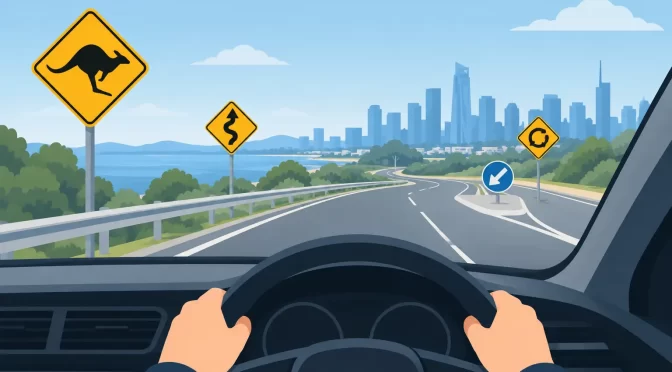
A curved-arrow sign may indicate a bend, while a kangaroo symbol warns of wildlife. Other common warning signs show traffic lights ahead, a roundabout, pedestrians, merging traffic or a slippery surface. Respond by checking your speed, increasing your awareness and preparing for the hazard. The right response depends on conditions. A sharp bend on a dry, empty road needs a different speed from the same bend in rain or peak-hour traffic.
Direction and service signs help you plan
Green signs usually provide directions to roads, suburbs and major routes. Blue signs commonly identify services or facilities, such as parking, hospitals or rest areas. These signs are not usually urgent instructions, but they help you choose the correct lane in good time.
If you are following a route to a driving-test location, do not make a last-second lane change because you have spotted a direction sign late. Continue safely and take the next suitable route if necessary. A missed turn is better than a rushed, unsafe manoeuvre.
Pay close attention to speed signs
Speed-limit signs are among the most important signs for learner drivers. In Victoria, the number inside the red circle is the maximum legal speed when conditions allow. It is not a target speed you must reach.
If it is raining, visibility is reduced, the road is narrow, or pedestrians are close to the road, drive at a speed that lets you stay in control. You can be travelling below the posted limit and still be driving too fast for the conditions.
Watch for changes around school zones, roadworks, shopping strips and major roads. School-zone signs display the operating times, and you must follow the lower limit during those times on school days. Do not assume the limit has ended just because you have passed the school buildings. Wait until you see the next speed sign.
Temporary speed signs at roadworks apply too. Orange roadwork signs, traffic controllers and changed lane markings require extra attention. Slow down early and follow the temporary directions, even if you drive through the area regularly.
Parking signs need a full read
Parking signs can feel confusing because several restrictions may be displayed on one pole. The key is to read from top to bottom and identify the details that apply to your vehicle and the current time.
Look for the permitted parking duration, days and times, permit-zone requirements, loading-zone rules and clearway restrictions. A sign may allow two-hour parking during the day but prohibit parking during peak times. Arrows show where the restriction starts and ends, so check whether the sign applies before or after the pole.
For learners, parking signs matter beyond avoiding a fine. During a driving test, stopping in a clearway, bus zone, no-stopping area or too close to an intersection can create a serious safety issue. If you are asked to pull over, take a moment to assess the signs, the kerb and the space before committing.
Signs, road markings and traffic lights work together
Do not read signs in isolation. Road markings, traffic lights and the road layout often confirm what you need to do.
At an intersection, a left-turn-only sign may be supported by a painted left-turn arrow in your lane. At a pedestrian crossing, signs, zebra markings and flashing lights may all appear together. On a multi-lane road, overhead signs and lane arrows help you move into the correct lane before the intersection.
When instructions appear to conflict, temporary traffic control signs and directions from an authorised traffic controller take priority. For example, roadworks may direct you around a closed lane even though the normal lane markings suggest a different path.
Build sign reading into every lesson
The fastest way to improve is to say signs out loud while you practise. You might quietly identify: “40 zone ahead”, “give way at roundabout”, “left lane ends” or “no stopping near intersection”. This trains your eyes to scan ahead and helps turn recognition into action.
Start with familiar local streets, then practise in different environments: shopping areas with complex parking restrictions, main roads with multiple lanes, quiet streets with hidden intersections and routes with school zones. If you have driven overseas, give yourself time to adapt. Australian signs may look familiar, but the road rules, lane use and testing expectations can be different.
During a VicRoads driving test, the assessor is watching your decisions as well as your vehicle control. Seeing a sign early, adjusting smoothly and following the instruction shows safe observation and good judgement. Hesitating is understandable when you are new, but ignoring a sign or reacting too late can be costly.
A patient instructor can help you practise real Melbourne traffic situations until reading signs feels automatic. Learning Path Driving School focuses on clear feedback, practical road skills and test-ready decision-making, so you know not only what a sign means, but what to do when you see it.
Next time you drive, give yourself one simple goal: spot each important sign early enough to respond without rushing. That small habit builds the awareness that helps you drive calmly, safely and confidently wherever the road takes you.