



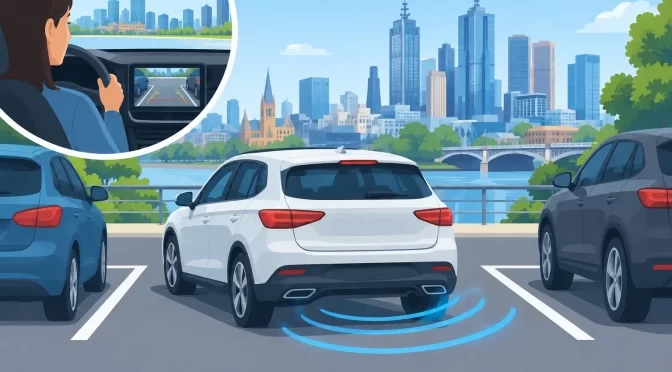
A reverse park can feel like the moment every other driver is watching, especially when cars are queued behind you on a busy Melbourne street. The good news is that learning how to reverse park confidently is not about guessing distances or turning the wheel quickly. It comes down to a repeatable routine: set up properly, check for hazards, reverse slowly and use reference points that suit your car.
For learner drivers, reverse parking is also a useful test of everyday driving skills. It shows that you can control the vehicle at low speed, observe properly and make calm decisions when space is limited. Get the sequence right in quiet streets first, and the same manoeuvre becomes much less stressful near shops, schools and test routes.
What confident reverse parking actually looks like
Confident parking does not mean doing it in one perfectly smooth movement every time. Experienced drivers still make small adjustments when a space is tight. Real confidence is knowing when to stop, straighten up, move forward slightly and try again without panicking.
A safe reverse park is slow, controlled and observant. You should be able to explain what you are checking and why: mirrors for the space and kerb, blind spots for pedestrians and cyclists, and the road behind you for approaching traffic. If someone walks behind the car, stop. If the space is clearly too small, drive on and find another one. That is good judgement, not a failure.
For a Victorian driving test, your instructor will help you practise the observations, signalling and control expected under current VicRoads standards. The exact street, vehicle and traffic conditions can vary, so avoid relying on a single magic steering point without understanding the reason behind it.
Set up before you begin the manoeuvre
Most reverse parks go wrong before the car starts moving backwards. Rushing into a space, stopping too close to the parked car or failing to check traffic leaves you trying to fix the position later.
Choose a space that gives you room to work. As a learner, look for a space comfortably longer than your vehicle rather than attempting the smallest gap on the street. Position your car alongside the vehicle in front of the space, leaving a sensible side gap. Your instructor can show you a reliable starting position for the car you are learning in, whether it is an automatic or manual.
Before reversing, indicate left if you are parking on the left side of the road. Check the centre mirror, left mirror and left blind spot, then assess what is happening behind you. A driver approaching from behind may need time to understand that you are about to park. Keep your brake lights visible and do not begin until it is safe.
Your key checks are:
- the footpath and road edge for pedestrians, scooters and prams
- the lane behind for vehicles, motorcycles and cyclists
- both sides of the parking space for doors opening or people stepping out
- the position of nearby driveways, intersections and restrictions
Do not treat mirrors as a substitute for looking around. Mirrors help you judge the kerb and parked vehicles, but direct observation is essential before and during reversing.
How to reverse park confidently, step by step
Once you are set up, keep the speed extremely low. In an automatic, this may mean controlling the car with the brake while it creeps in reverse. In a manual, use clutch control carefully and avoid releasing the clutch too fast. Fast reversing gives you less time to observe and makes every steering correction bigger than it needs to be.
Start by reversing straight back slowly. Look mainly through the rear window in the direction of travel, with regular mirror checks. As your car reaches the point where the rear needs to enter the space, turn the steering wheel towards the kerb. The amount of turn depends on the size of the space and your starting position, which is why practising in the same vehicle matters.
Watch the car behind you and the kerb-side mirror. Your aim is to bring the rear of your vehicle into the space while maintaining safe clearance from the parked vehicle. When your car reaches an angle of roughly 45 degrees to the kerb, begin steering the other way to bring the front of the car in.
This is the stage where learners often turn too late. If the front of your car is still sticking out into the lane, keep reversing slowly while steering away from the kerb to straighten the vehicle. If you are becoming too close to the kerb, stop and correct before touching it. A small forward adjustment is safer than forcing the car into position.
Finish parallel to the kerb, centred within the space and close enough to the kerb without mounting it. Secure the vehicle with the handbrake, select park in an automatic or the appropriate gear in a manual, and complete a final check before opening the door.
Use reference points, but do not depend on them blindly
Reference points are useful because they give beginners something specific to look for. For example, an instructor might use the alignment of a rear window, head restraint or door mirror with the parked vehicle to tell you when to begin steering. These points can make the manoeuvre feel far more predictable.
However, reference points are personal to the vehicle and seating position. A taller driver, a different car or an adjusted seat can change what you see. Learn the reference point, then connect it to the result: the rear of the car is now lined up to enter the space, or the front needs to swing in.
Adjust your seat, mirrors and steering position before every drive. Sitting too far back or too low makes it harder to judge distance and can turn a familiar reverse park into a guess. Good vehicle setup is one of the simplest ways to build consistency.
Common mistakes that make reverse parking harder
Looking only at the kerb is a common problem. It may help you avoid a gutter strike, but it can make you miss a pedestrian or reverse too close to the car behind. Keep scanning, and pause when you need more time to assess the situation.
Another mistake is over-steering. Learners often wind the wheel rapidly to fix a small issue, then have to make a larger correction in the opposite direction. Slow hands and slow vehicle speed give you more control. Steering should be deliberate, not frantic.
Some drivers also feel pressured by traffic waiting behind them. You are allowed to take the time needed to park safely. Stay aware of other road users, but do not rush a manoeuvre simply because another driver is impatient. If the situation becomes unsafe or the space no longer feels suitable, move on.
Finally, avoid practising only in empty car parks. Car parks are useful for learning reverse control, but kerbs, parked cars and normal street traffic create different visual cues. Build up gradually from quiet residential streets to busier local areas.
Practise for a driving test and real Melbourne streets
Test preparation should make you a better everyday driver, not teach you to memorise one parking spot. Practise reverse parking on both flatter and slightly sloped roads, in spaces of different lengths and with different parked vehicles. Melbourne streets can be narrow, busy and uneven, so adaptability matters.
Ask for clear feedback after each attempt. Did you check your blind spot before reversing? Were you controlling the speed? Did you finish safely and legally? A patient instructor can spot small habits early, such as crossing your hands excessively, staring at one mirror or forgetting to scan for pedestrians.
At Learning Path Driving School, one-to-one lessons can break the manoeuvre into manageable stages, then build it back into a smooth test-ready routine. This is particularly helpful for anxious learners, overseas licence holders adjusting to Victorian driving expectations, and anyone who has avoided parallel parking after a bad experience.
Confidence grows from calm repetition, not from forcing yourself into the tightest gap on the first day. Start with a space that gives you room, use the same safety checks every time, and allow yourself to correct the car when needed. Before long, reverse parking will feel like a controlled routine rather than a moment to dread.
