
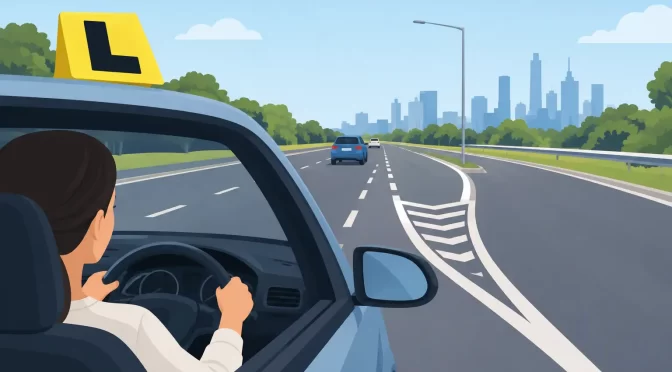
A slip lane can look simple: turn left, merge into traffic and continue. Yet it is one of the places Victorian learners most often hesitate, brake too late or miss a pedestrian. This guide to slip lane rules Victoria explained gives you the clear, practical approach you need for everyday Melbourne driving and your VicRoads test.
The key point is this: a slip lane is normally controlled by a Give Way sign, not by the traffic lights beside it. You must assess the road ahead, give way properly and enter only when it is safe. Rushing because the cars behind you are waiting is never the right choice.
What is a slip lane?
A slip lane is a separate lane that lets vehicles turn left at an intersection without travelling through the main set of traffic lights. It is usually divided from through-traffic lanes by a traffic island, often with a curved path leading into the road you are joining.
You will commonly see slip lanes at larger Melbourne intersections, particularly on busy arterial roads. Most have a Give Way sign near the end of the lane. Some may also have pedestrian crossings, bicycle lanes or a clearly marked stop line.
Do not confuse a slip lane with an ordinary left-turn lane. If you are in a normal left-turn lane beside the traffic lights, those lights apply to you. In Victoria, you cannot turn left through a red traffic light unless a sign or signal specifically permits that movement. A genuine slip lane is physically separated and usually has its own Give Way control.
Slip lane rules in Victoria: who gives way?
When you approach the end of a slip lane, you must give way before entering the road. That means giving way to traffic already travelling on the road you are joining, including vehicles approaching close enough that entering would force them to brake, slow down or change direction.
You must also give way to pedestrians crossing the lane you are turning into or crossing your path. This matters even when a pedestrian is moving slowly, looking at their mobile or has only just stepped from the kerb. As the driver making the turn, it is your responsibility to wait.
Cyclists need the same careful attention. A rider may be travelling in a marked bicycle lane, on the road beside you or across the slip-lane entrance. Check properly before moving. Never assume a cyclist is travelling slowly enough for you to pull out in front of them.
At a Give Way sign, you do not always have to come to a complete stop. If you have a clear view and there is nobody to give way to, you can continue at a safe, controlled speed. But if your view is blocked, traffic is approaching, or a pedestrian may be entering the crossing, slow down early and stop if needed.
The traffic lights may not control the slip lane
This is where many learners get caught out. The main traffic lights can be red while traffic is still able to move through a separate slip lane, provided it is safe and there is no red signal specifically controlling that lane.
Do not treat the green light for through traffic as permission to enter without checking either. The Give Way sign and the conditions in front of you still matter. Watch the slip lane itself, not just the signal heads across the intersection.
A safe slip-lane routine for learner drivers
A consistent routine helps you make calm decisions under pressure. As you enter the slip lane, begin reducing speed early and look well ahead to identify the Give Way sign, pedestrian crossing and joining point.
Then use this sequence:
- Check your mirrors as you slow down, especially the left mirror for cyclists.
- Scan the pedestrian crossing and footpath before looking for a gap in traffic.
- Look right for approaching vehicles on the road you are entering.
- Select a safe gap, then move smoothly into the nearest appropriate lane without cutting across lanes.
Your final checks should be active, not a quick glance. Look right, check ahead, then look right again if you have been waiting. Traffic can appear quickly, particularly on multi-lane roads where one vehicle can hide another.
Once the way is clear, accelerate positively enough to join the traffic flow. Being overly hesitant after you have selected a safe gap can create its own problem. Good driving is controlled and decisive, not rushed or uncertain.
Choosing a safe gap
There is no single number of seconds that works at every slip lane. The safe gap depends on the speed limit, traffic speed, weather, visibility, road width and your vehicle’s ability to accelerate.
A gap that feels comfortable on a quiet 40 km/h shopping strip may be unsafe on a 70 km/h arterial road. If cars are travelling faster than expected, rain has reduced grip, or a large ute or truck is blocking your view, wait for a larger gap.
Be especially cautious when joining a road with two or more lanes. A vehicle in the nearest lane may stop or turn, giving you the impression that the road is clear, while another vehicle continues in the next lane. Do not enter until every lane you need to cross or join is clear.
You should also avoid stopping unnecessarily halfway through a slip lane. If the lane is long enough to allow you to wait safely at the Give Way line, do that. Stopping across a pedestrian crossing or rolling into the path of traffic puts you in a difficult position and can be assessed as unsafe driving.
Common slip-lane mistakes on the driving test
VicRoads assessors are looking for safe observation, correct gap selection and controlled vehicle handling. A slip lane is not a trick, but it can reveal whether a learner is scanning properly and making independent decisions.
The most common error is focusing only on vehicles from the right and forgetting pedestrians or cyclists. Another is rolling through the Give Way sign without properly checking for traffic. Even if there happens to be no car nearby, a rushed observation pattern can be obvious.
Some learners stop when the road is clear because they are unsure whether the traffic lights apply. Others see a gap, hesitate too long and miss it, then pull into a much smaller gap out of pressure. Remember: the driver behind you does not decide when it is safe to go.
Lane position also matters. Follow the curve of the slip lane, keep left unless road markings direct otherwise, and enter the correct lane for your next move. Do not swing wide into another lane or immediately change lanes after joining unless there is a clear reason and it is safe.
What if there is a pedestrian crossing in the slip lane?
Many slip lanes have a pedestrian crossing before the Give Way point. Treat it seriously. Slow down enough that you can stop smoothly if someone is approaching, waiting at or already on the crossing.
A pedestrian may cross from either side, and a person with a pram, mobility aid or child may take longer to clear the lane. Wait until they have safely crossed your path before moving on. Do not edge the car forward to pressure them or block the crossing while waiting for traffic.
If the crossing has its own red or green pedestrian signals, obey the traffic controls while still maintaining awareness. A green vehicle signal never removes your duty to avoid a collision.
Build confidence through practice, not guesses
Slip lanes become easier when you practise them on different roads and in different traffic conditions. Start on a quieter intersection where you can recognise the layout and take time to observe. Then progress to busier Melbourne roads, multi-lane entries and slip lanes with pedestrian crossings.
A patient instructor can help you develop the timing that is hard to learn from road rules alone: when to begin slowing, where to look, how long to wait and how to accelerate into a genuine safe gap. At Learning Path Driving School, lessons can focus on the intersections and test-style situations that make you feel least confident.
The best habit is simple: approach slowly, look for every road user, give way when required and move only when the gap is clearly safe. That calm routine will serve you far beyond the driving test.