



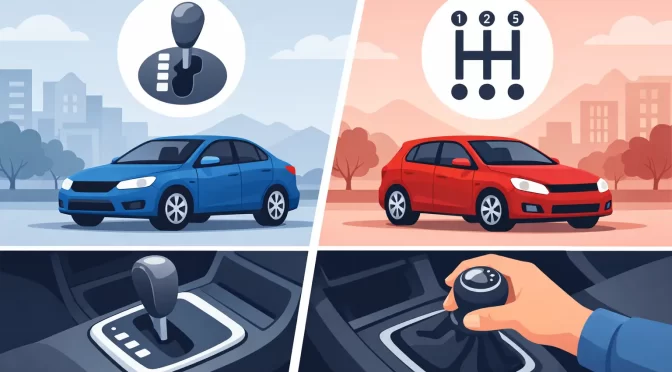
Your choice of test vehicle can affect every car you are allowed to drive after you pass. For learners weighing up an automatic versus manual licence in Victoria decision, the key question is simple: do you want the fastest path to a licence now, or the flexibility to drive either transmission later?
There is no single right answer. An automatic licence can be the smart, low-stress choice for nervous beginners, busy adults and many overseas licence holders. A manual licence takes more practise, but it keeps more driving options open. The best choice is the one that helps you become safe, confident and genuinely ready for the Victorian driving test.
What changes when you test in automatic or manual?
In Victoria, the transmission of the vehicle you use for your practical driving test matters. If you pass your test in an automatic vehicle, your licence will carry an automatic transmission condition. This means you can drive automatic vehicles, but not manual vehicles, until you complete the required assessment in a manual car and have the condition removed.
If you pass the test in a manual vehicle, you can legally drive both manual and automatic cars. That is the main advantage of learning manual.
Your learner permit does not place the same automatic-only restriction on you. You may learn in either type of vehicle, provided you meet Victorian learner requirements and drive with an appropriate supervising driver. The restriction is generally determined by the vehicle used for your licence test.
Automatic versus manual licence in Victoria: the real trade-off
An automatic car has no clutch pedal and does not require you to select gears while moving through traffic. You can place more attention on steering, mirrors, speed control, intersections, pedestrians, cyclists and the decisions assessed in the driving test.
For many Melbourne learners, that means progress comes sooner. If clutch control is making you stall, panic at lights or lose focus on the road, an automatic lesson can build confidence quickly. This can be particularly helpful on busy local roads, around shopping strips, tram corridors and complex roundabouts.
A manual car requires you to manage the clutch, gears and engine speed while also reading traffic conditions. It is a worthwhile skill, but it can feel demanding in the first stages of training. Learners need time to practise smooth take-offs, hill starts, gear changes, slowing safely and recovering calmly if the car stalls.
The advantage is flexibility. A manual licence allows you to drive a wider range of vehicles, including some older cars, work vehicles and vehicles shared within families. If you may need to use a manual car for work, travel or family reasons, investing the extra practise time now can save you from upgrading later.
When an automatic licence is the better choice
Automatic is often the practical option when your priority is getting safely licensed without unnecessary delay. Most newer cars on Melbourne roads are automatic, and many learners will only ever drive an automatic vehicle after they pass.
Choose automatic if you are finding the physical coordination of manual driving distracting, if you need your licence within a defined timeframe, or if you will have reliable access to an automatic car after your test. It can also be a sensible choice for learners who have had a long break from driving and want to rebuild road confidence step by step.
Automatic training is not an “easy option” in the sense of lowering the driving standard. You still need to demonstrate observation, safe gap selection, correct speed, lane position, head checks, hazard response, parking and independent decision-making. You simply remove gear changes from the workload.
For anxious learners, this matters. A calmer driver is better able to listen, scan ahead and respond safely. Passing quickly is valuable, but passing with the confidence to drive independently afterwards is the real goal.
When learning manual is worth the extra effort
Manual lessons suit learners who want maximum flexibility or who know they will need to drive a manual vehicle. You may be planning to use a family car, work on sites where manual vehicles are common, or buy an affordable older first car. In these situations, a manual licence can give you more choices.
Manual training can also make you more aware of vehicle momentum and speed because you are actively selecting gears. However, it does not automatically make someone a safer driver. Safe driving comes from consistent observation, patience, hazard awareness and good judgement – skills that matter in both transmission types.
Be realistic about your timeline. A learner who needs a licence soon may be better served by automatic training, especially if manual basics are still causing frequent stalls or rushed decisions. You can always work towards a manual upgrade later. On the other hand, if you have time to practise regularly and your goal requires manual access, starting in manual can be more efficient than learning automatic first and returning for another test.
Cost, lesson time and practise requirements
Manual lessons are not always more expensive per lesson, but they can require more practise before you feel test-ready. The first few sessions often focus heavily on clutch control, gear selection and moving off smoothly. That is normal, not a sign that you are failing.
Automatic learners may reach the stage of practising test routes, reverse parking and independent driving sooner because vehicle control is simpler. But every learner progresses differently. A confident manual learner who practises consistently may be ready before an automatic learner who only drives occasionally.
The most cost-effective approach is not choosing the vehicle with the shortest-looking path. It is booking lessons that address your actual weak points, then combining professional feedback with safe supervised practise where possible. A clear lesson plan prevents you from spending money repeating exercises you have already mastered.
At Learning Path Driving School, patient instructors can help you assess whether automatic or manual training suits your confidence, vehicle access and licence goals. Honest feedback early can save time, stress and avoidable lesson costs later.
What the Victorian driving test still assesses
Whether you take the test in an automatic or manual, the assessor is looking for safe, legal and controlled driving. Your preparation should cover more than parking manoeuvres or memorising a test area.
You need to show that you can check mirrors and blind spots at the right times, maintain a safe following distance, recognise changing speed zones, position the car correctly and make safe decisions at intersections. You also need to respond appropriately to pedestrians, school zones, trams, cyclists and unexpected hazards.
In a manual test, smooth gear handling is part of vehicle control. A stall is not automatically the end of a test, but it can become a problem if it creates a safety risk, holds up traffic significantly or shows a lack of control. The best preparation is to practise recovery: secure the car, restart calmly, observe properly and move when safe.
In an automatic test, do not let the simpler transmission make you complacent. Many learners fail because of missed head checks, poor observation at roundabouts, incorrect speed choices or hesitation that disrupts traffic. Your instructor should train you to understand why each action is needed, not simply follow a script.
A practical way to decide before booking lessons
Start with the car you expect to drive most often after you get your licence. If it is automatic and you have no likely need for a manual, automatic training is usually the direct choice. If your household, job plans or future car options involve manual vehicles, manual training deserves serious consideration.
Next, consider your available practise time. Manual requires patience and regular repetition. If you can practise each week and are comfortable progressing gradually, the skill is achievable. If your schedule is tight and your immediate priority is becoming an independent driver in an automatic car, do not feel pressured into manual simply because someone else thinks you should.
Finally, be honest about confidence. The right lesson environment should challenge you without overwhelming you. Start with fundamental controls, then move through quiet streets, busier traffic, parking, roundabouts, highway driving and realistic VicRoads test preparation as your skills grow.
Can I change from automatic to manual later?
Yes. If you pass in an automatic vehicle and later want to drive manual, you can work towards having the automatic condition removed by meeting the applicable Victorian licensing requirements in a manual vehicle. Check current VicRoads requirements before booking, as licensing rules and processes can change.
Is a manual driving test harder?
It has an extra layer of vehicle control because you need to use the clutch and gears correctly. The road rules, observation standards and safety expectations are the same. It is harder only if you are not yet comfortable managing the car while making safe decisions around traffic.
Should overseas licence holders choose automatic or manual?
Choose based on the vehicle you will drive in Victoria and any conditions that apply to your licence conversion pathway. Experienced drivers can still benefit from lessons focused on Victorian road rules, local test expectations, hook turns where relevant, speed zones and observation habits.
The best licence choice is the one that matches your real driving life, not someone else’s preference. With steady practise, clear coaching and a test plan built around your needs, you can move from learner nerves to confident, capable driving.
